The Calvari (Calvary steps)
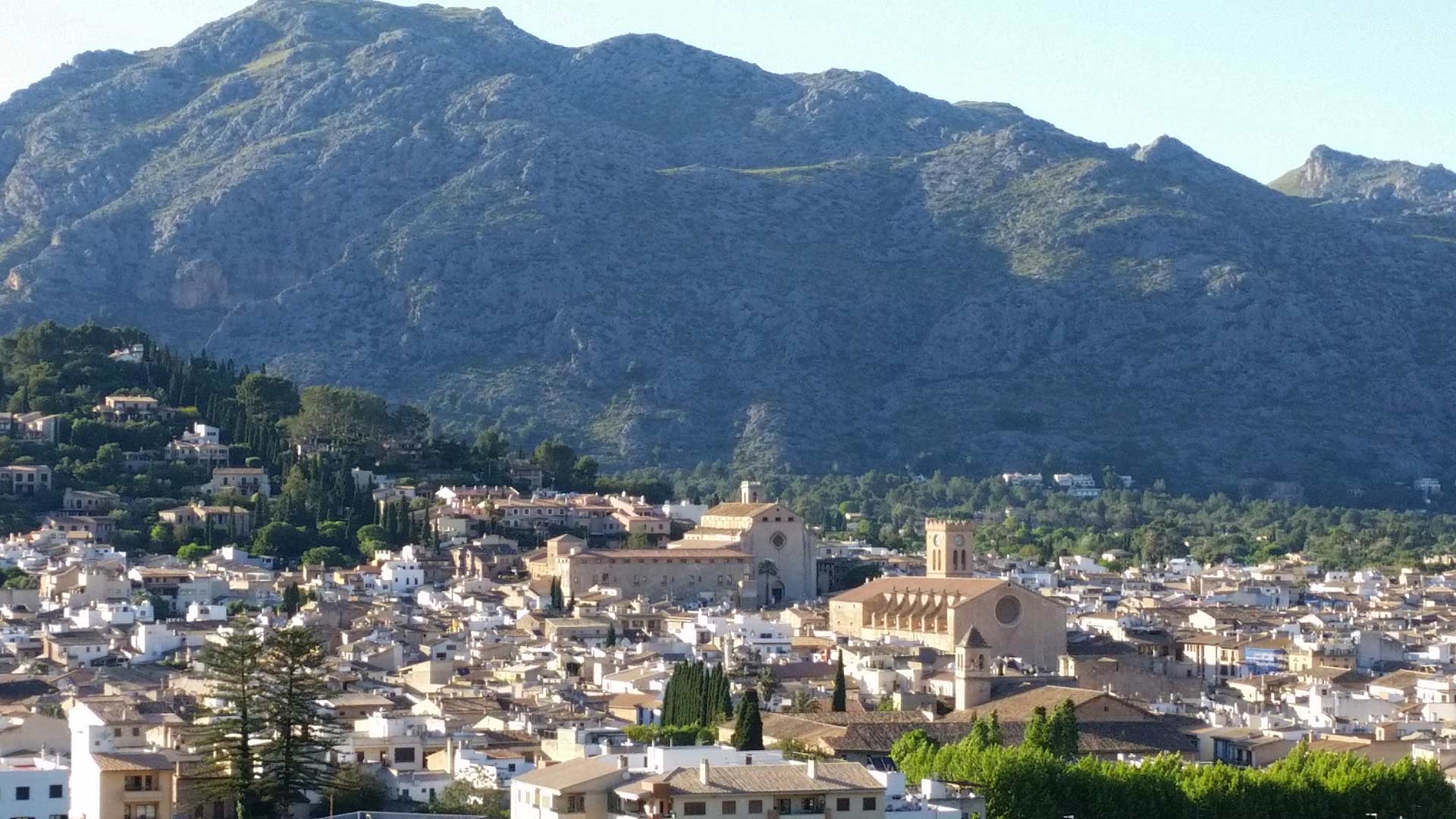
A flight of 365 cypress-lined steps climbs from the centre to the Calvari chapel. At the top is one of the best views of the town, the bay and the mountains. Best first thing in the morning or at sunset.
Area guide
What we’ve been recommending to our guests since 1988: villages, beaches and coves, walks and day trips, markets, where to eat and when to go. All less than an hour from your villa.
All our villas are in the municipality of Pollença or a few minutes away: in the countryside around the town, near Port de Pollença, in Cala Sant Vicenç or on the road to Alcúdia. It’s a special corner of the island: the Tramuntana mountains, a World Heritage Site, meet two large bays of calm water here, and within twenty kilometres you’ll find historic towns, fine sandy beaches, rocky coves and some of the best walking and cycling routes on Mallorca.
This guide starts with Pollença, which we know as home, and then opens out to the rest of the north. Distances are approximate and measured from the centre of Pollença.
Our town
Pollença is a town of stone, narrow streets and squares lined with café terraces, and it has kept a life of its own. It has drawn painters and writers for over a century, and it shows: there are galleries, a classical music festival every summer and one of the liveliest calendars of traditional fiestas on Mallorca.
A flight of 365 cypress-lined steps climbs from the centre to the Calvari chapel. At the top is one of the best views of the town, the bay and the mountains. Best first thing in the morning or at sunset.
The main square, overlooked by the church of Our Lady of the Angels, is where the town meets. On Sunday mornings it fills with the market: local fruit and veg, cured meats, cheese, basketry and crafts.
The stone bridge over the Sant Jordi stream, at the entrance to the town, is one of Pollença’s landmarks. Although it’s called Roman, its present form is later. The cockerel, the town’s emblem, crowns the Font del Gall fountain in Plaça de l’Almoina, a short walk from Plaça Major.
The hill you can see from all over town has a medieval sanctuary at the top. It’s a walk of just under an hour, up a narrow road and then a cobbled path. The reward: views over both bays and, often, a drink at the hostelry.
The cloister of the former Dominican convent houses the Pollença Museum and, in July and August, the Pollença Festival: open-air classical concerts since the 1960s. It’s worth booking tickets early.
The Casa Museu Dionís Bennàssar remembers the town’s best-known painter, and there are several galleries in the old town. For a wander with no particular aim: the streets between the Plaça Major, the Calvari and the Pont Romà.
TipParking in the centre is difficult in summer and on Sunday market days. There are car parks on the edge of town, five minutes’ walk from the square.
Our villas in this area
 Reco Verd
Sleeps up to 6 · From €3.500 / week
 Villa BELLA VISTA
Sleeps up to 8 · From €3.700 / week
 Muntalegre
Sleeps up to 9 · From €4.600 / week
 Villa Agnes
Sleeps up to 8 · From €3.800 / week
 Llangana
Sleeps up to 6 · From €2.500 / week
 Villa Can Lluis de la Luz
Sleeps up to 8 · From €7.500 / week
 Can Verd
Sleeps up to 8 · From €4.235 / week
 Villa Maronja
Sleeps up to 8 · From €4.400 / week
 Finca Playa Llenaire
Sleeps up to 8 · From €5.500 / week
 Villa Antigua
Sleeps up to 8 · From €6.380 / week
 Gotmar Beach
Sleeps up to 10 · From €7.480 / week
 Can Perot
Sleeps up to 8 · From €4.180 / week
Further reading

Pollença by the sea
The town’s port, Port de Pollença (Puerto Pollensa), looks out over a large, sheltered bay with shallow, almost always calm water. It’s ideal for families with children, for trying sailing or paddleboarding and for a seaside stroll at any time of day.
The waterside promenade, shaded by pines, runs north from the marina past old houses and little beaches. It’s the classic sunset walk, with the sun going down behind the mountains.
Fine sand and water that stays shallow for many metres, with facilities in season. Towards Alcúdia, Llenaire beach and the Gotmar area are quieter.
Around the bay there are sailing, windsurfing and paddleboarding schools, kayak and boat hire, and diving centres. Conditions are good for learning.
Scheduled boats run from the port to Formentor beach, along with trips along the coast of the cape. A good alternative to driving at the height of summer.
On Wednesday mornings there’s a market in the Port, with food, clothes and craft stalls.
TipThe Bóquer valley, one of the prettiest and easiest walks in the area, starts on foot from the Port itself (see Walks and day trips).

The cape
The Formentor peninsula is the northern tip of the island: a winding road between cliffs over 300 metres high that ends at the lighthouse. It’s one of the most dramatic landscapes on Mallorca, and it’s right on the doorstep of our villas.
The first stop on the way up from the Port. Steps lead to a balcony above the sea with views of the cliffs and the Colomer islet.
An old watchtower above the viewpoint, reached along a track. From the top you can see the bays of Pollença and Alcúdia and the whole peninsula.
A long beach of white sand, with pines almost down to the water and views across the bay. You can get there by car or by boat from the Port.
Two wilder, pebbly coves with very clear water, reached on foot from the road. Perfect for snorkelling.
At the end of the road, the lighthouse looks out to sea from the top of the cape. The light at sunrise and sunset is spectacular.
TipIn recent summers, access to the lighthouse by private car has been restricted in the middle of the day, with shuttle buses running from the Port. The dates change every year: ask us before you go.
Further reading

Rocky coves
A small residential village at the foot of the Cavall Bernat cliffs, with four coves of turquoise water in a row. Quieter than the Port and much loved by those who come for swimming and snorkelling.
Cala Barques, Cala Clara, Cala Molins and Cala Carbó, all a few minutes’ walk from one another. Cala Molins is the largest; Cala Carbó the most secluded.
The rocky seabed and clean water make Cala Sant Vicenç one of the best places in the north to see fish. The seafront path links the coves.
Next to the coves are prehistoric burial caves cut into the rock, free to visit.
The seafront terraces are a good place to end the day, watching the sun colour the cliffs.
TipIn August it’s best to arrive early: the coves are small and parking is limited.
Our villas in this area

History and the bay
Ten minutes from Pollença, Alcúdia combines a walled old town, the remains of the island’s most important Roman city and a sandy bay several kilometres long.
The medieval walls enclose a centre of pedestrian streets with shops, café terraces and grand townhouses. You can walk along the top of some sections.
Just outside the old town are the ruins of Pollentia, founded by the Romans, with its small theatre. Round off the visit at the town’s museum dedicated to the site.
Alcúdia’s market, in and around the walls, is one of the liveliest in the north.
The marina has a promenade, restaurants and boat trips. At Alcanada there’s a seafront golf course and an islet with a lighthouse.
On the Victòria peninsula, among pines and above the sea, the hermitage is the starting point for walks with some of the best views in the area.
TipThe old town is pedestrianised: leave the car in the car parks by the walls.
Beaches and coves
The north has a bit of everything: big sandy beaches for families, rocky coves for snorkelling and spots you can only reach on foot or by boat.

Fine sand and very shallow water for many metres. The easiest with young children.
White sand, pines and crystal-clear water. One of the most beautiful on the island.
Four coves of turquoise water at the foot of the cliffs.
Small, quiet beaches between the Port and Alcúdia.
Several kilometres of sand with full facilities and water sports.
Dunes, pines and shallow water next to the s’Albufera nature park.
Pebbly coves on Formentor, reached on foot from the road.
A pebble beach on the Victòria peninsula, only reachable on foot or by boat.
TipWhen the north wind (tramontana) blows, the coves at Formentor and Cala Sant Vicenç can get choppy; the beaches in the bays are usually sheltered. And the other way round with a southerly wind.
On foot, by bike and by car
The Tramuntana starts in Pollença. There are routes for every level and, in spring and autumn, the weather is perfect for walking or cycling.

From the Port, a valley between the mountains down to little Cala Bóquer. Easy, about 2 hours there and back. You’ll often see wild goats and birds of prey.
A climb from the town to the sanctuary, with views over both bays. Just under 1 hour up.
From the Es Colomer viewpoint, along a track to the watchtower. Views over the whole Formentor peninsula.
From the hermitage, routes to the Penya des Migdia or the Talaia d’Alcúdia, with the sea below you.
Mallorca’s most important sanctuary, deep in the mountains about 20 km away. Boys’ choir (els Blauets), botanical garden and footpaths.
A spectacular mountain road winds down to the mouth of a great gorge. Best avoided at peak times.
The Tramuntana’s long-distance path ends in Pollença. Some stages, such as Lluc to Pollença, can be done in a day.
The north is one of Europe’s best-known cycling destinations: the climb to Formentor, the Coll de sa Batalla and the flat roads towards Alcúdia and s’Albufera.
TipIn summer, set off very early, take plenty of water and avoid the middle of the day. Some mountain paths cross private estates: please respect the signs.
Further reading

Natural areas
The largest wetland in the Balearics, between Alcúdia and Muro. Flat trails and birdwatching hides; highly recommended in spring and autumn. Entry is via the visitor centre.
A small wetland between Pollença and Alcúdia, beside the bay road, also good for birdwatching.
A UNESCO World Heritage Site since 2011, for its landscape of terraces, cobbled paths and dry-stone buildings.

Where to eat
Rather than a list that changes every season, we tell you where to look. Once you’re here, just ask us: we’ll recommend somewhere to suit what you fancy.
Terraces for a morning coffee or an aperitif, and restaurants serving Mallorcan and modern cooking in the streets of the centre and at the foot of the Calvari.
Fish and seafood overlooking the bay, rice dishes and terraces at sunset all along the promenade and the Pine Walk.
Only a few restaurants, nearly all with views of the coves. Ideal for a quiet dinner.
Restaurants and taverns in the old town; in Port d’Alcúdia, more international food around the marina.
Restaurants on country estates and in rural houses along the Lluc road and around Pollença, often with seasonal cooking.
Pa amb oli, tumbet, frit mallorquí, arròs brut, fish caldereta, sobrassada, ensaïmada and the island’s wines.
TipIn July and August, book a table for dinner, especially at weekends. At lunchtime many restaurants offer a set menu of the day (menú del día).
Further reading

Markets and shopping
Markets are the best way to get to know the island’s produce. They’re usually held in the morning, until one or two o’clock.
| Sunday | Pollença (Plaça Major), Alcúdia and Sa Pobla |
|---|---|
| Tuesday | Alcúdia |
| Wednesday | Port de Pollença, and Sineu, the oldest traditional market on the island |
| Thursday | Inca, one of the biggest on Mallorca |
TipTo take home: olive oil, sobrassada, ensaïmadas, sea salt and flor de sal, palm-leaf basketry and roba de llengües (traditional Mallorcan “tongue” fabric).
Further reading

With children
The bays of Port de Pollença and Alcúdia are perfect for little ones.
Boats run along the coast from Port de Pollença and Port d’Alcúdia; some have glass bottoms.
Near Alcúdia beach there’s a water park for a different kind of day out.
The Port de Pollença promenade and the paths at s’Albufera are flat and safe for cycling with children.
About 25 minutes away are the Coves de Campanet, with guided tours through chambers of stalactites.

Calendar
TipExact dates change every year. If your stay coincides with a fiesta, we’ll let you know.

Practical information
From Palma airport it’s about 60 km by motorway (Ma-13), around 50 minutes. We can book you a taxi or transfer.
A car is the most practical option. There are buses (TIB) between Pollença, the Port, Alcúdia and Palma, and taxis in the towns.
Hot, dry summers and mild winters. May, June, September and October are ideal for combining the beach with walking.
The sun is strong even in spring: take sun cream, a hat and water on walks.
The emergency number is 112. There are health centres and chemists in Pollença, the Port and Alcúdia.
Our office is in Pollença. During your stay you can call us for any recommendation or help.
Your base in the north
All our villas are a few minutes from the places in this guide. Tell us your dates and we’ll help you choose.
Guide information reviewed in 2026. Opening times, access and dates may change: check before you go or ask us.


 Reco de Marina
 Can Toni
 Can Seguinot d Alt
 La Fortaleza
 Villa Playa
 Can Domingo